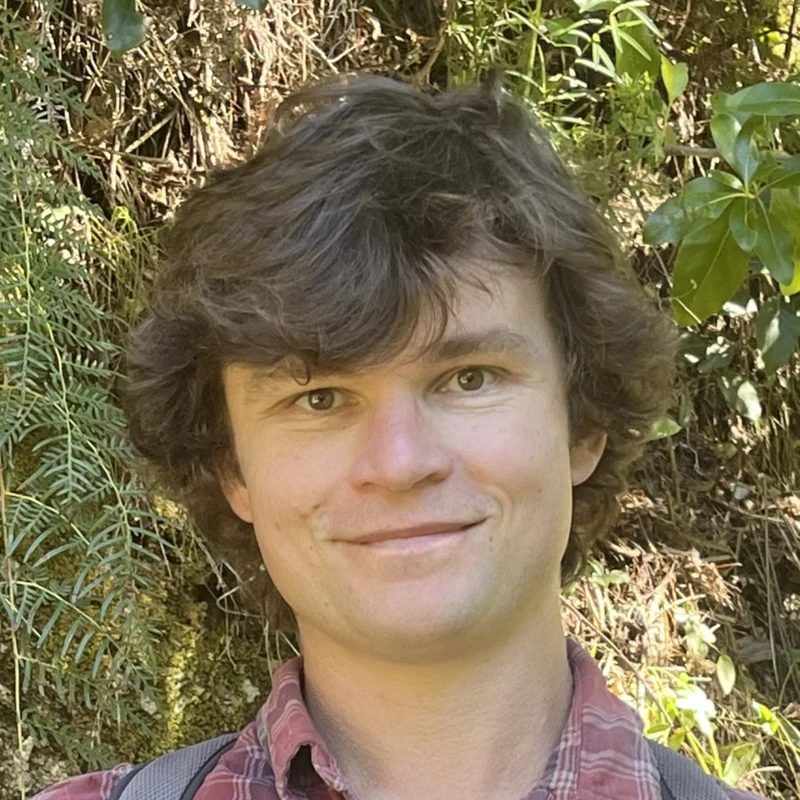
Gene Howson
Gene Howson is a PhD candidate in Civil and Environmental Engineering at the University of Canterbury as part of the KAMA project. He holds a BSc in Environmental Science and MScs in Ecosystem Management and Biodiversity Conservation and in Environmental Engineering from Newcastle University, UK. Before relocating to Christchurch in 2025 he worked in environmental science education and research in Peru, followed by ecological monitoring in the USA.
Integrating Environmental DNA, Remote Sensing and Field Surveys for Scalable Biodiversity Assessment
Aotearoa New Zealand is internationally recognised for its unique biodiversity yet also has one of the highest rates of indigenous biodiversity loss. Conventional biodiversity monitoring approaches are usually expensive, time-consuming and primarily focused on public conservation land. These constraints limit their spatial and temporal coverage. Meanwhile, approximately half of the land area is managed for production, where landowners and managers lack practical, cost-effective tools for biodiversity assessment. Without scalable and standardised assessments in these landscapes there is still uncertainty on the state of biodiversity nationwide. This paper outlines the challenges for biodiversity data and information in Aotearoa and explores how integrating emerging technologies can support scalable and cost-effective assessment. It then presents a framework for using environmental DNA (eDNA), remote sensing and field surveys for catchment-based biodiversity assessment. Preliminary results demonstrate strong correlations between remote sensing-derived terrestrial condition, land use, management, climatic and geomorphological combined factors with eDNA-derived biota. Ongoing fieldwork in Te Tai-o-Aorere/Tasman aims to clarify knowledge gaps in eDNA sampling by testing how outcomes vary across space and time. The proposed framework enables the identification and validation of biodiversity indicators from multiple data sources. Suitable indicators that pass validation checks can support the development of a practical, multi-scale biodiversity assessment tool. The use of this integrative tool can deliver evidence-supported outcomes from practice and policy aligned with the Aotearoa New Zealand Biodiversity Strategy.
Kai Anamata mō Aotearoa
10–12 November 2026 · Motueka Memorial Hall